Free Printable Habit Tracker PDF - Why Pen and Paper Beats Every App
Table of Contents
Every January, roughly 40% of Americans set New Year’s resolutions. By February, 80% have already quit.
The usual playbook looks like this: download a habit app, set up push notifications, feel motivated for a week, then swipe away the reminders until you eventually delete the app.
Sound familiar?
Here’s the thing most people overlook. The problem isn’t willpower. It’s the medium. A notification buried in your phone is effortless to ignore. A sheet of paper on your fridge? Not so much.
Download the Free Habit Tracker PDF →
The Free Habit Tracker PDF
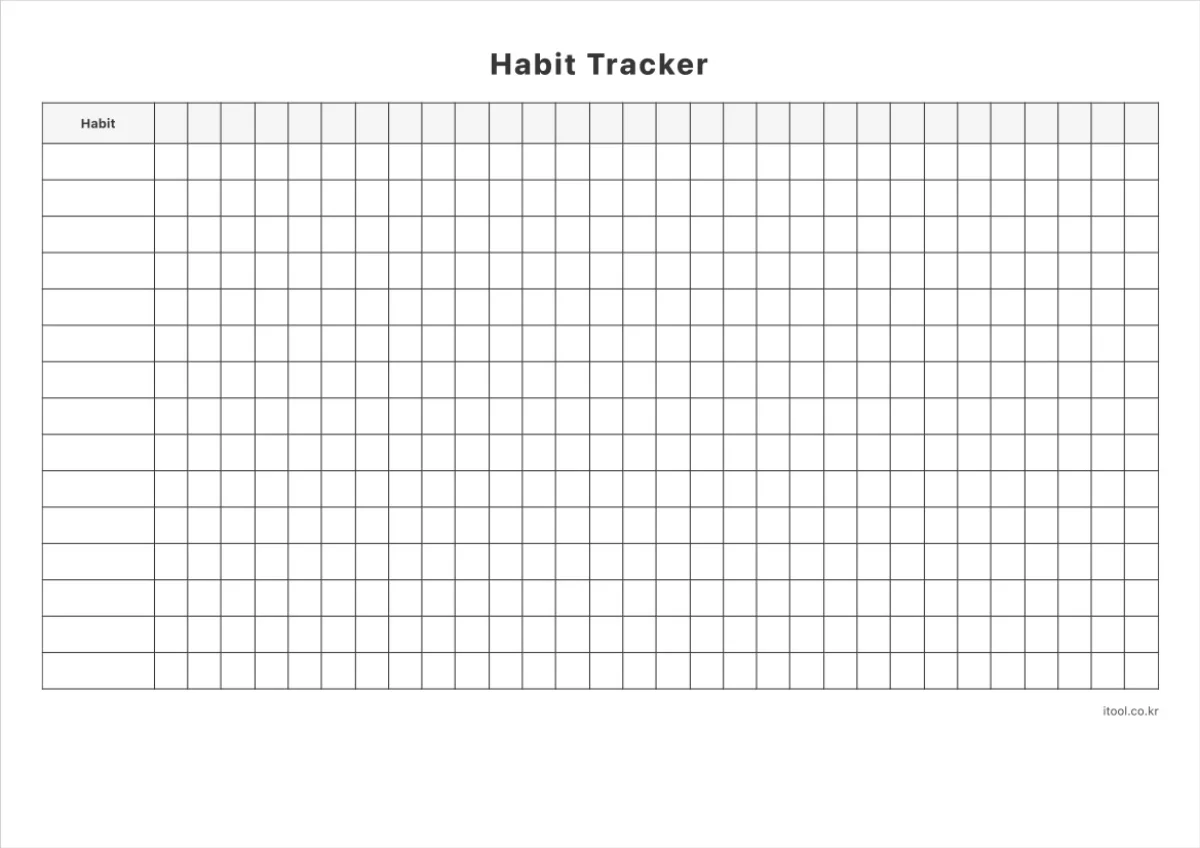
A simple, landscape A4 grid with 15 blank rows. No pre-printed dates, no structure you have to conform to. Start on a Tuesday in March or a Saturday in October – it doesn’t matter.
Print it out. Stick it somewhere you’ll see it every single day: the fridge, your bathroom mirror, your desk. That’s the entire setup.
The Science Behind Why Paper Works
Writing Things Down Makes You 42% More Likely to Succeed
Dr. Gail Matthews at Dominican University of California studied 267 participants across a range of backgrounds and professions. She split them into groups: some simply thought about their goals, others wrote them down.
The group that wrote their goals on paper was 42% more likely to achieve them.
Why? The physical act of writing engages your brain differently than typing. Neuroscience research consistently shows that handwriting activates deeper cognitive processing and strengthens memory encoding. When you write something by hand, your brain treats it as more important.
As James Clear puts it in Atomic Habits: “Until you write it down, it’s just a wish.”
Behavioral Visibility – If You Can See It, You Do It
Psychologists call this the behavioral visibility effect.
A push notification takes one thumb-swipe to dismiss. But a tracker pinned to your wall? You see it when you grab your morning coffee, when you pass through the kitchen, when you’re brushing your teeth at night.
Every time you notice an empty checkbox, your brain registers a small gap between intention and action. And every time you fill one in, you get a tiny hit of satisfaction – a micro-reward that makes you want to come back tomorrow.
Jerry Seinfeld used a version of this when he was building his comedy career. He hung a big wall calendar and marked a red X for every day he wrote new material. His only rule: “Don’t break the chain.” The visual streak of X’s became its own motivation.
App Fatigue Is Real
The average American has over 80 apps on their phone. Between Todoist, Notion, Streaks, Habitica, and a dozen others, there’s a real cost to adding yet another digital tool to the pile. Every app competes for the same limited attention.
Paper doesn’t ping you. It doesn’t gamify things or try to upsell you to a premium plan. It just sits there, quietly reminding you of what you said you’d do. Sometimes simplicity is the unfair advantage.
How to Use Your Habit Tracker (4 Practical Tips)
1. Start With 3 to 5 Habits Max
It’s tempting to go all in. Wake up at 5 AM, meditate, journal, exercise, read 30 pages, eat clean, practice a language…
James Clear calls this “the plateau of latent potential.” You stack too many changes at once, see no immediate results, and quit everything.
Pick one or two habits so small they feel almost silly. Drink a glass of water when you wake up. Do five push-ups after brushing your teeth. Read one page before bed.
Once those feel automatic, add another.
2. Be Specific, Not Vague
| Instead of… | Write this |
|---|---|
| Exercise | 20 squats |
| Read more | Read 10 pages |
| Drink water | Drink 500ml by noon |
| Sleep early | Lights off by 11:30 PM |
Vague goals let you rationalize. “I sort of exercised today” becomes “I walked to the mailbox.” Specific goals are binary: you either did it or you didn’t. That clarity is what makes the checkbox meaningful.
3. Remember the 66-Day Rule
You’ve probably heard “it takes 21 days to form a habit.” That number comes from a 1960s observation by a plastic surgeon – not from behavioral science.
The real answer comes from Dr. Phillippa Lally’s research team at University College London. They tracked 96 people building new habits and found that it takes an average of 66 days for a behavior to become automatic.
Simple habits like drinking water can lock in around 18 days. Complex ones like running every morning can take over 250 days. The point isn’t to obsess over the number – it’s to understand that this takes longer than you think, and that’s completely normal.
The study also found something reassuring: missing a single day didn’t significantly derail long-term habit formation. One slip doesn’t reset the clock. Just pick it up again tomorrow.
4. Don’t Break the Chain
Make checking your tracker a habit in itself. Every night before bed, take 60 seconds to review your day and fill in the boxes.
After a week, you’ll see a row of checkmarks forming a chain. After two weeks, that chain becomes something you don’t want to break. The visual record of your effort is its own motivation – no app notification needed.
Build a Custom Tracker
The free PDF works great for getting started. But if you want something more tailored, the iTool Habit Tracker lets you:
- Auto-fill dates and days for any month
- Color-code weekends so you can visually separate work days
- Pre-type habit names directly in the tracker before printing
- Print to landscape A4 with one click
No sign-up, no download. Just configure and print.
Create Your Custom Habit Tracker →
Frequently Asked Questions
Q. What does the habit tracker PDF look like?
It’s a clean, landscape A4 grid with 15 blank rows. No pre-printed dates or days, so you can start any time of the year.
Q. Is a paper tracker really more effective than an app?
Research from Dominican University found that people who wrote down their goals were 42% more likely to achieve them. A physical tracker posted where you can see it adds behavioral visibility, which boosts follow-through.
Q. Can I make a custom habit tracker?
Yes! The iTool Habit Tracker lets you set the month, auto-fill dates and days, color-code weekends, and pre-type your habit names before printing.
Q. How long does it actually take to form a habit?
A study from University College London found it takes an average of 66 days. Simple habits can stick in as few as 18 days, while complex ones can take over 250 days. And missing one day won’t reset your progress.
Q. What’s the best way to start building habits?
Start with one or two habits so small you can’t fail – drink a glass of water, do five push-ups. Small wins build real confidence, and confidence is what makes bigger habits possible.
Related Tools
Habit Tracker - Create a custom monthly habit tracker
Calendar Print - Print monthly calendars on A4
Character Counter - Count words and characters in your journal
You don’t need another app. You need a piece of paper and a pen.
Download the free PDF, pick one tiny habit, and don’t break the chain.
Related Posts
Text Diff Tool Guide - Find Document Differences Instantly
Compare two texts and spot differences in seconds. Perfect for contract revisions, code reviews, and translation checks. Free online diff tool guide.
Character Counter Guide - Count Words, Characters & Bytes Instantly
Learn how to use the free online character counter tool. Count characters, words, lines, and bytes in real-time with handy text editing features.